Waypoint 03 of 06 — Six Waypoints

Quark Nuggets & Magnetar Pulsars

What are Quark Nuggets, and what do Magnetar Pulsars tell us about them?

01
Dark Matter
02
Normal Matter & Quarks
03
Quark Nuggets & Magnetars
04
Aggregation vs. Decay
05
Detection
06
Capture

Quark nuggets are composed of Up, Down, and Strange quarks in essentially equal numbers. They are also called strangelets, nuclearites, Axion Quark Nuggets (AQNs), and Macros, in addition to Magnetized Quark Nuggets (MQNs). Since Bodmer (1971) suggested that collections of Up, Down, and Strange quarks should be stable, many theorists have shown that large aggregations of this combination of quarks should be even more stable than protons and neutrons.

Quark nuggets have not been observed in high-energy accelerator experiments because single Up-Down-Strange particles would decay in about 10 picoseconds — too fast to detect. Consequently, the search for dark matter candidates has focused on particles beyond the Standard Model. Since those searches have not produced a candidate, interest in Standard-Model-consistent candidates like quark nuggets has grown substantially, as shown in the publication trend below.
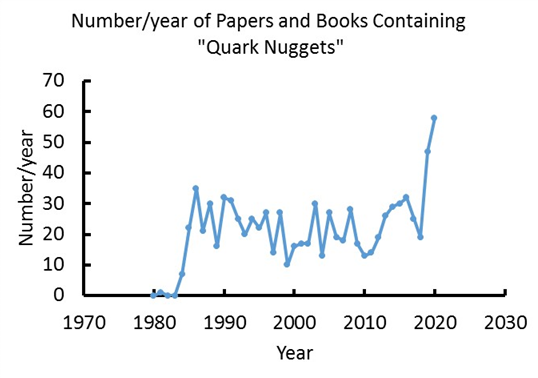
Publications per year mentioning quark nuggets
Growing Scientific Interest

Number of publications per year mentioning quark nuggets — showing a marked increase as Standard-Model-consistent dark matter candidates attract renewed attention.

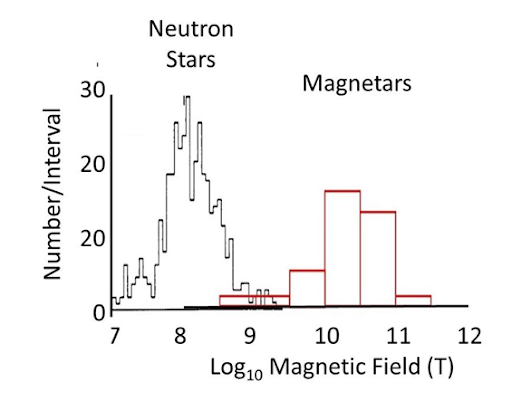
Magnetic field comparison: neutron star pulsars vs magnetar pulsars
Magnetars vs. Neutron Stars

Magnetars have magnetic fields ~300× stronger than neutron star pulsars. Tatsumi's theory proposes their cores are ferromagnetic quark liquid — in other words, an MQN.

Neutron Stars (1993): Taylor, Manchester & Lyne.
Magnetars (2014): Olausen & Kaspi.

Most papers on quark nuggets had not explicitly included the effects of magnetic fields. Tatsumi (2000) developed a theory showing that quark nuggets may explain the extreme magnetic fields of magnetar pulsars. Tatsumi's theory states that the core of each magnetar is a ferromagnetic liquid of nuclear density — in other words, an MQN.

"Magnetars are the first observational evidence consistent with MQNs."

The ferromagnetic nature of MQNs is the basis of the model of aggregation in the early universe. If MQNs formed the cores of magnetars, the same physics that produced those extreme fields may have produced the dark matter that fills the universe today.

References

  1. Bodmer, A. R. Collapsed Nuclei. Phys. Rev. D 4, 6, 1601–1606 (1971).
  2. Tatsumi, T. Ferromagnetism of quark liquid. Phys. Lett. B 489, 280–286 (2000).
  3. Taylor, J. H., Manchester, R. N., and Lyne, A. G. Catalog of 558 pulsars. Astrophys. J. Sup. 88, 529–568 (1993).
  4. Olausen, S. A., Kaspi, V. M. The McGill magnetar catalog. Astrophys. J. Sup. 212, 1, 6, 22 pp. (2014).

Next — Waypoint 04 of 06

Aggregation vs. Decay

Continue →