Quarks are essential parts of the Standard Model of Particle Physics — the very successful theory of particles and fields that explains the workings of the universe. The Standard Model equivalent of the familiar periodic table of chemical elements is shown below. There are six types of quarks: Up, Down, Top, Bottom, Charm, and Strange (shown in purple).
Normal matter is composed of neutrons and protons. Protons have two Up quarks and one Down quark. Neutrons have two Down quarks and one Up quark, as illustrated in the helium atom diagram below.
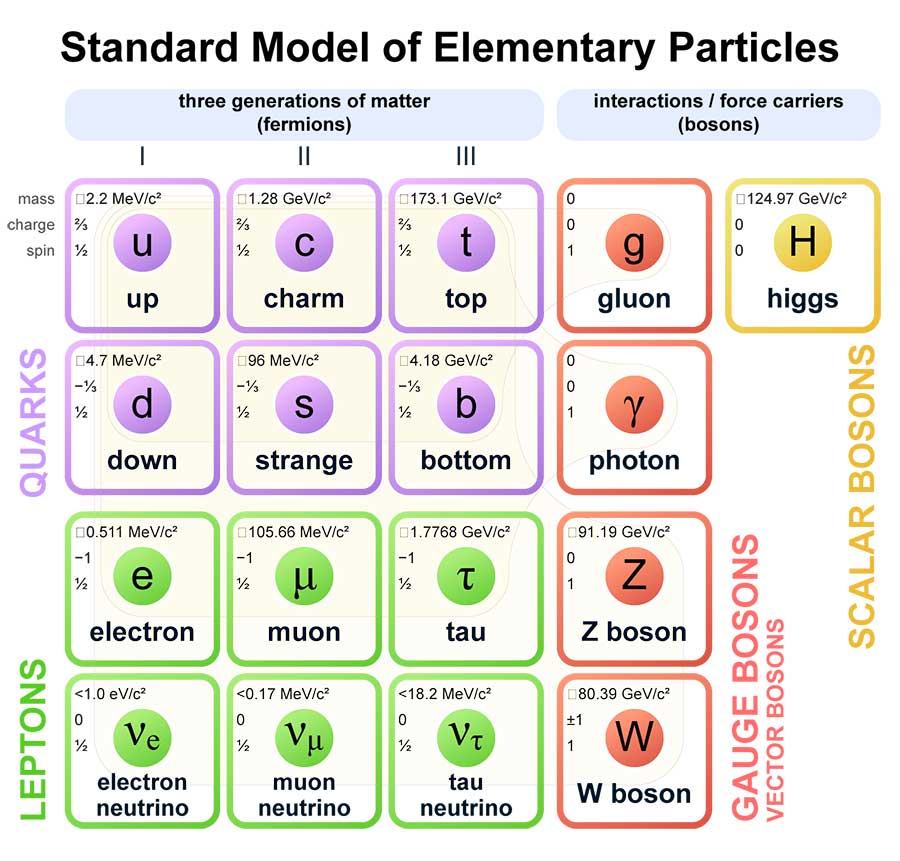
Standard Model of Elementary Particles
The theoretical framework describing all known fundamental particles and forces. Six types of quarks — Up, Down, Top, Bottom, Charm, and Strange — are shown in purple.
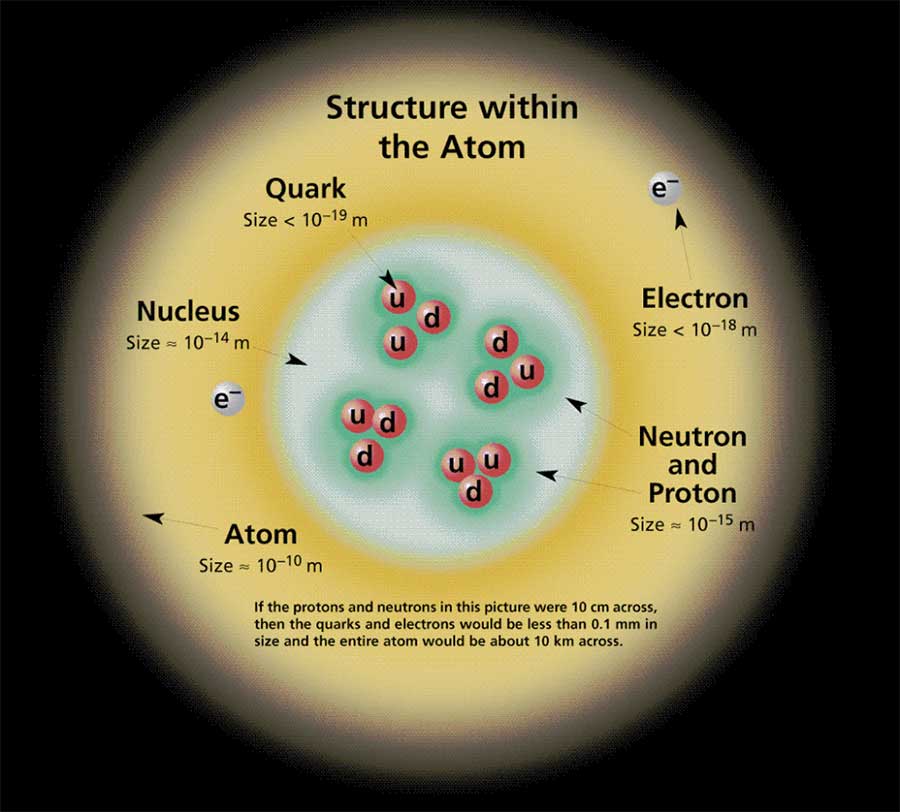
Quark Composition of Normal Matter
Protons (2 Up + 1 Down quark) and neutrons (2 Down + 1 Up quark) as illustrated in a helium atom. Image credit: The Standard Model of Particle Physics: A Lunchbox’s Guide by Dave Fehling.
References
- Oerter, R. The Theory of Almost Everything: The Standard Model, the Unsung Triumph of Modern Physics; Penguin Group: New York, NY, USA, 2006; 203–218.