MQNs can be detected through their interaction with matter via their ~trillion-tesla magnetic field. An MQN passing through dense matter at high velocity forms a magnetopause — a boundary at which the compressed magnetic field pressure equals the flowing particle pressure, just as Earth's magnetopause is formed by the solar wind.
5a Detection via Non-Meteorite Impacts
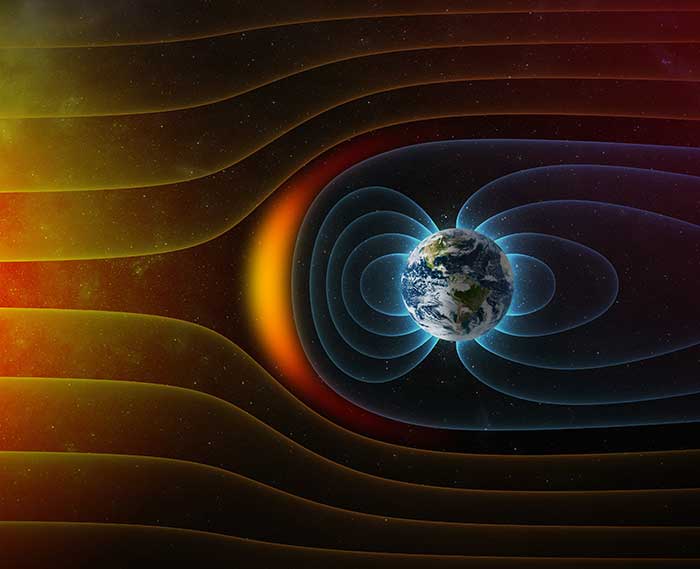
Earth's Magnetopause Analogy
The MQN magnetopause is thousands of times larger than the geometric size of the nuclear-density object, so energy deposited per unit length is correspondingly larger.
We have shown that energy transfer between matter and the MQN magnetopause can be very large. MQN impacts with Earth are consistent with non-meteorite craters reported approximately annually:
- A 12-m diameter crater was reported near Managua, Nicaragua, on September 6, 2014. [Cooke, W. Did a meteorite cause a crater in Nicaragua? (2014); CNN (2014)]
- Another event occurred on July 4, 2015, at the Salty Brine Beach in Rhode Island, USA. [Shapiro, E., Cathcart, C. & Donato, C. Bomb squad, ATF investigating mysterious explosion at Rhode Island beach (2015)]
- On February 6, 2016, an event occurred in Tamil Nadu, India. [Hauser, C. That wasn’t a meteorite that killed a man in India, NASA says (2016)]

County Donegal, Ireland — 1985
A non-meteorite crater shortly after the impact in May of 1985 in a peat bog (County Donegal, Ireland). Photo was taken by investigating Garda Mick Galligan and is used by permission of his daughter, Ms. Emer Galligan McMullen shown in the photograph.
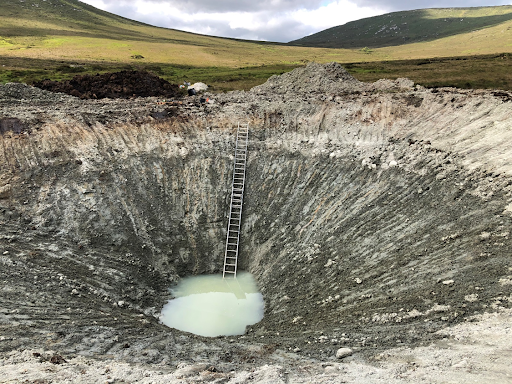
County Donegal, Ireland — 2019 Excavation
Photo of the same non-meteorite crater during excavation to the bedrock in July 2019. Six characteristics of the crater and subsurface structure were consistent with MQN impact. See our paper on this event: arXiv:2007.04826.
5b Detection by Rotating Magnetic Field
MQNs rotate as they pass through matter and can spin up to millions of revolutions per second (Nature.com, 2017). They can be detected through the effects of their rotating magnetic field after slowing down by passing nearly tangentially through Earth (Universe, 2021). Similar episodic events have been reported by Soviet Naval captains.
We have shown that an event reported in 1878 in the Proceedings of the Royal Society is consistent with a million-kilogram rotating MQN that lasted ~20 minutes, leaving at least three trenches in a peat bog — including a 25-meter diversion of a stream recorded in a previous ordnance survey.
Animation
1868 Stream Diversion — County Donegal, Ireland
Video walk-through of the 25-meter diversion of the stream during the 1868 event, after the Council excavated the blockage in the 1980s and restored the stream to its original path as recorded in the 1863 Ordnance Survey map.
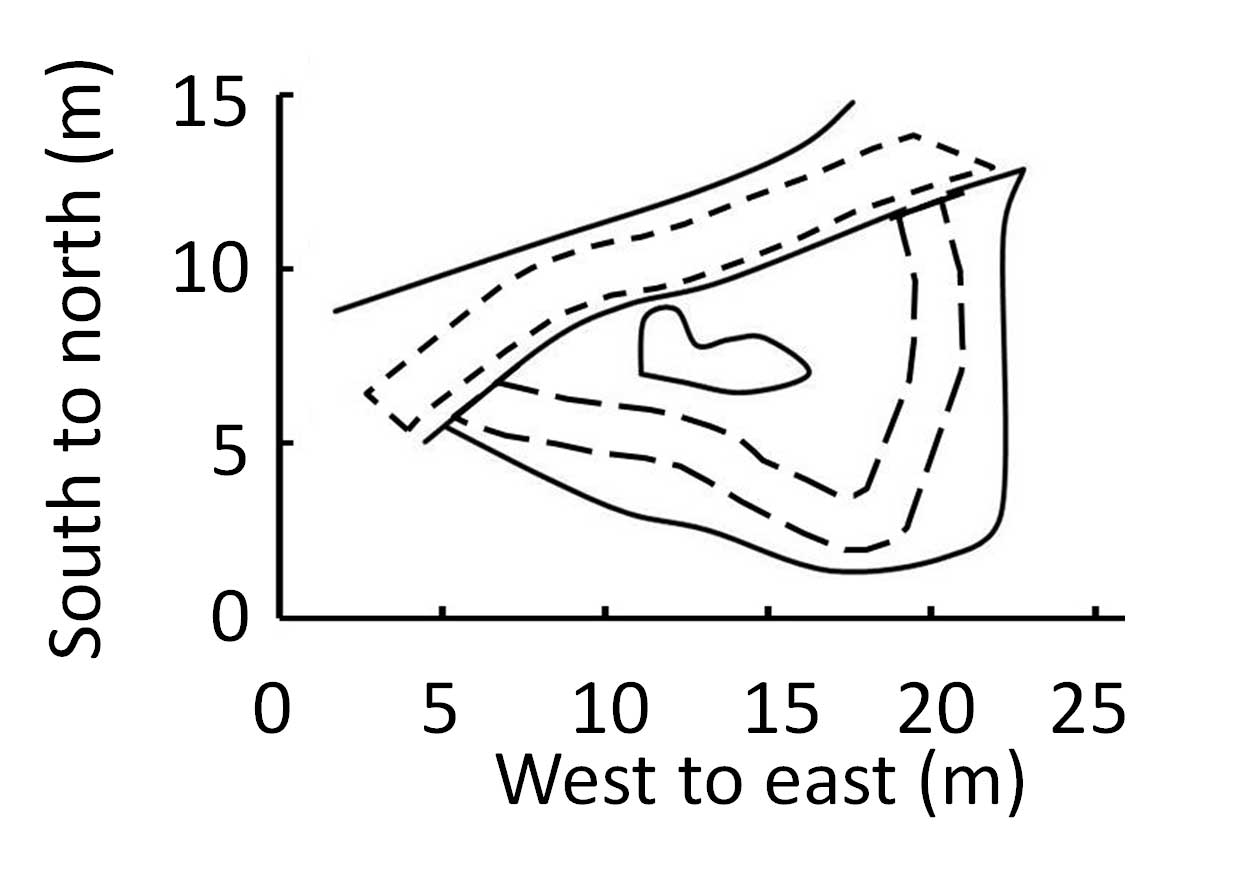
Site Contour Map — 1868 Event
Solid lines: surface level. Long dashes: bottom of the ball-lightning-cut channel at −1.2 ± 0.25 m. Short dashes: bottom of the stream as cut by the County Council in the 1980s at −1.9 ± 0.2 m. Orientation to north is approximate.
5c Detection by Radiofrequency Emissions
Episodic events support the MQN hypothesis, but more systematic data are needed. Since rotating magnetic fields radiate electromagnetic energy, MQNs can be detected by their radiofrequency emissions after passing through Earth's atmosphere and emerging into the outer magnetosphere.
Detection with three satellites in the outer magnetosphere appears to be the most promising path to systematic observation.
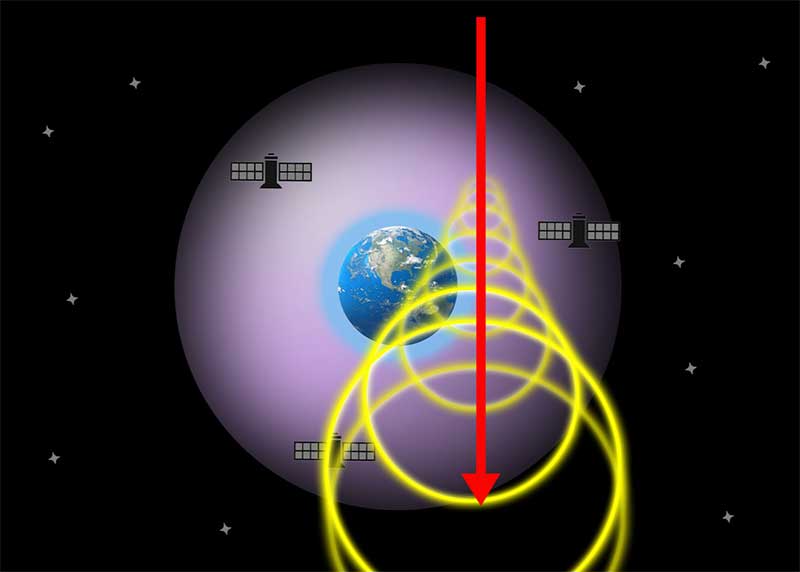
Proposed Satellite Detection Architecture
Three satellites in the magnetosphere (purple) monitoring RF emissions (gold) generated by MQN transit (red arrow). Nature.com →
References
- Pravdivtsev, V., Underwater Phantoms, UFO's Diving, Video, Russian TV Program #1, cited in Klimov, A. AIS-2008 Conference on Atmosphere, Ionosphere, Safety (2008).
- Fitzgerald, M. Notes on the occurrence of globular lightning and of waterspouts in County Donegal, Ireland. Quarterly Proceeding at the March 20th, 1878, Proceedings at the Meetings of the Society. Quarterly Journal of the Meteorological Society. 1Q1878, 160–161 (1878).